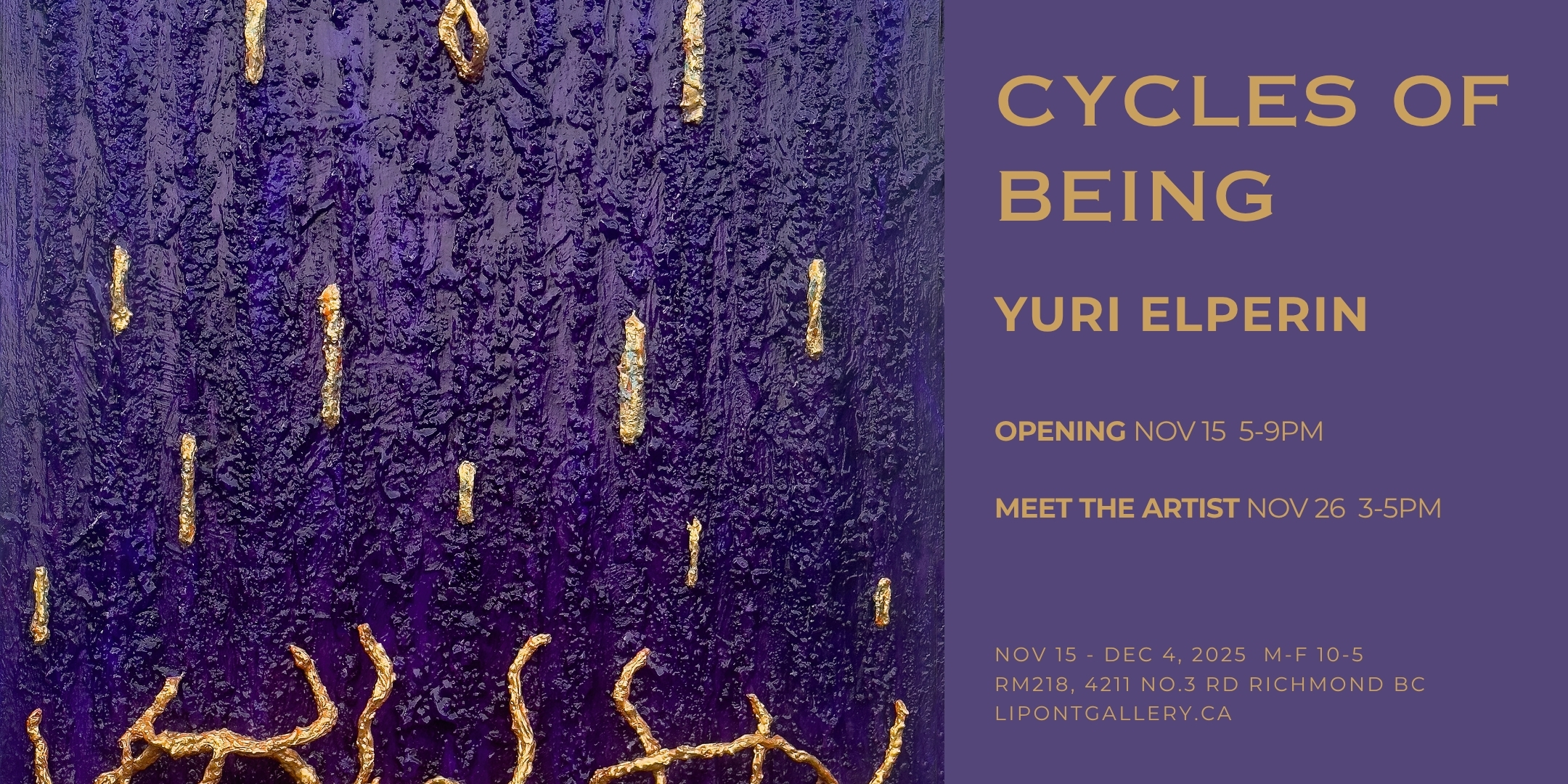
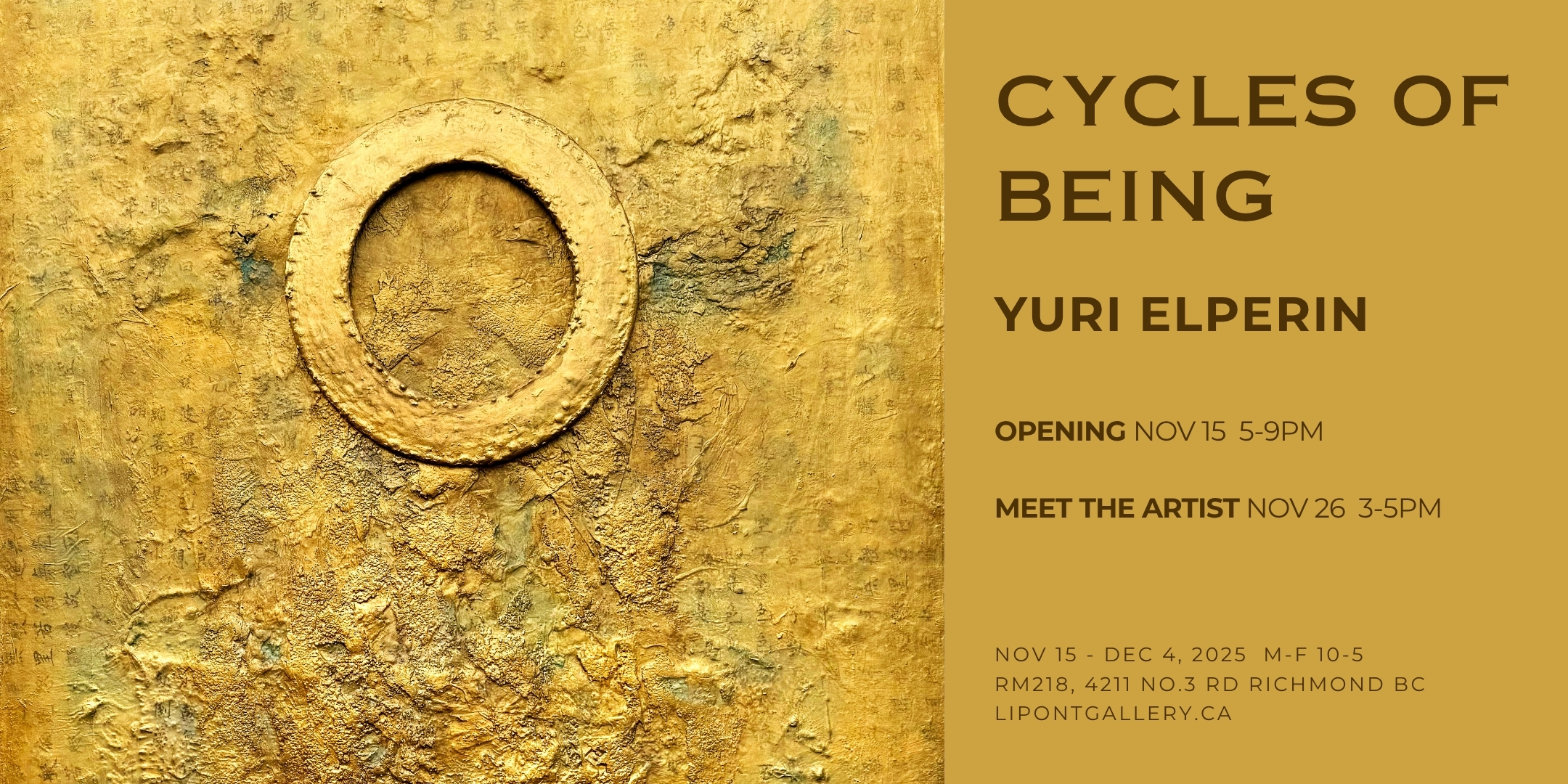
CYCLES OF BEING – ART BY YURI ELPERIN
Opening November 15th 2025 5-9pm
https://yuriopening.eventbrite.ca
Meet the Artist November 26th 3-5pm
https://meetyuri.eventbrite.ca
Exhibition: Nov 15 – Dec 4, 2025
Mon – Fri 10 – 5 or by appointment
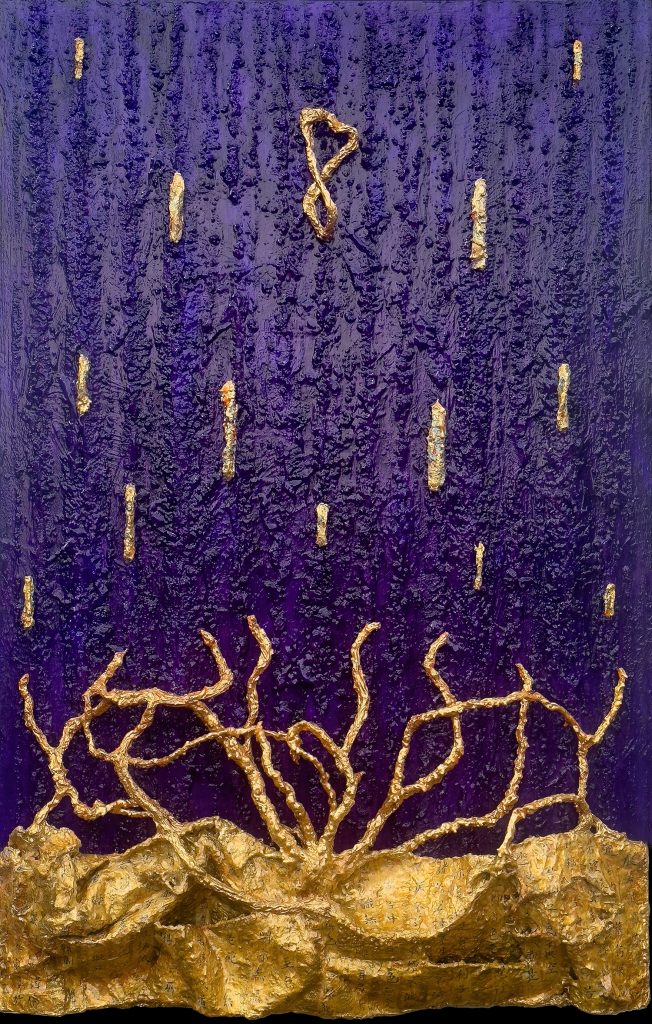
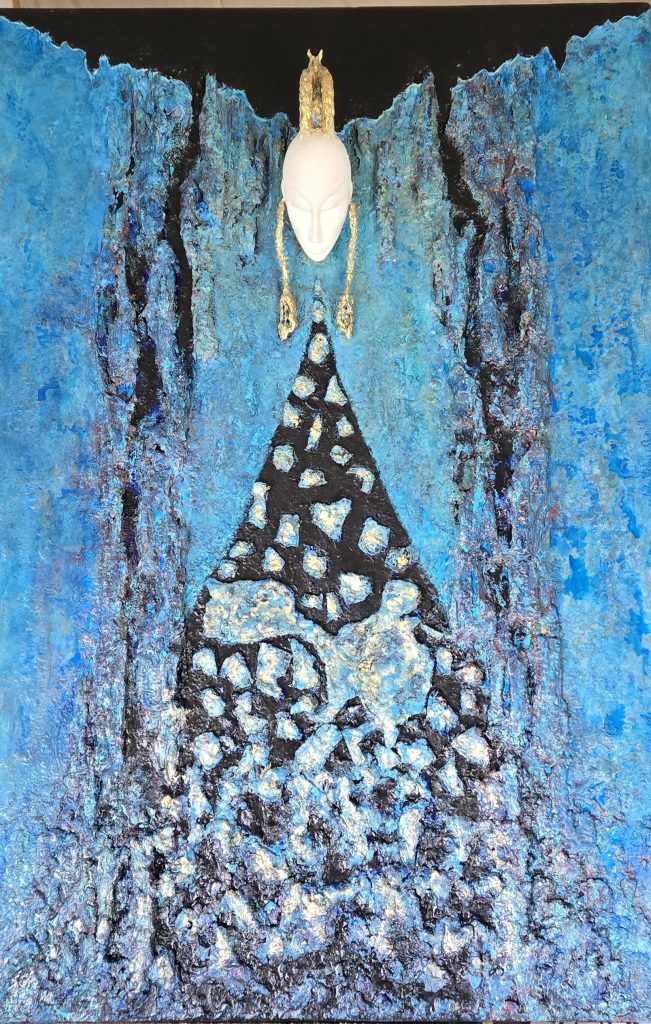
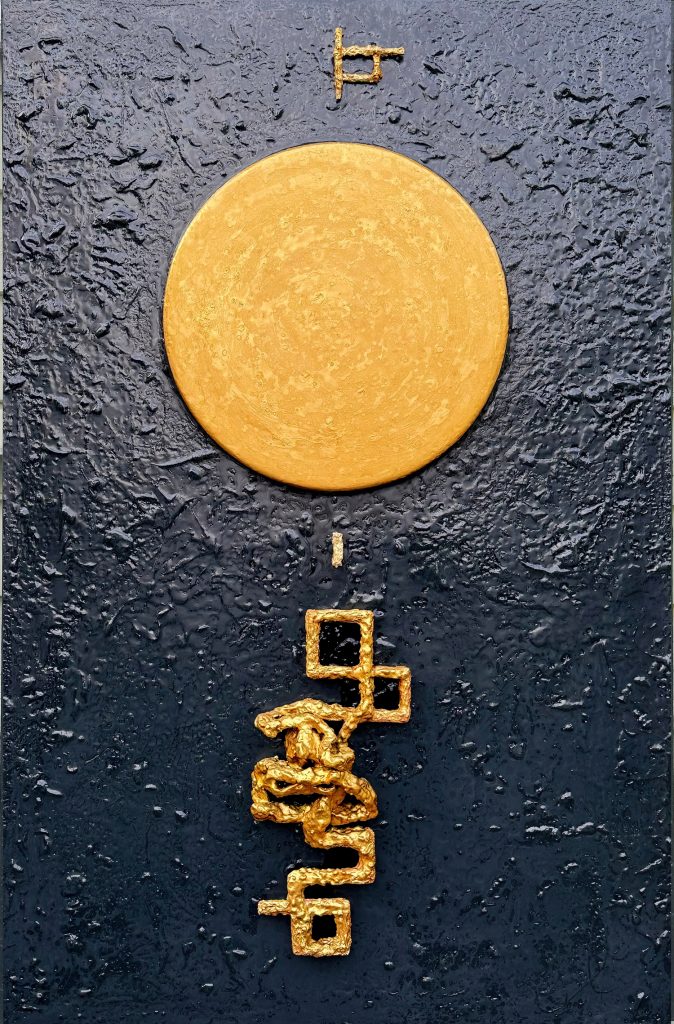
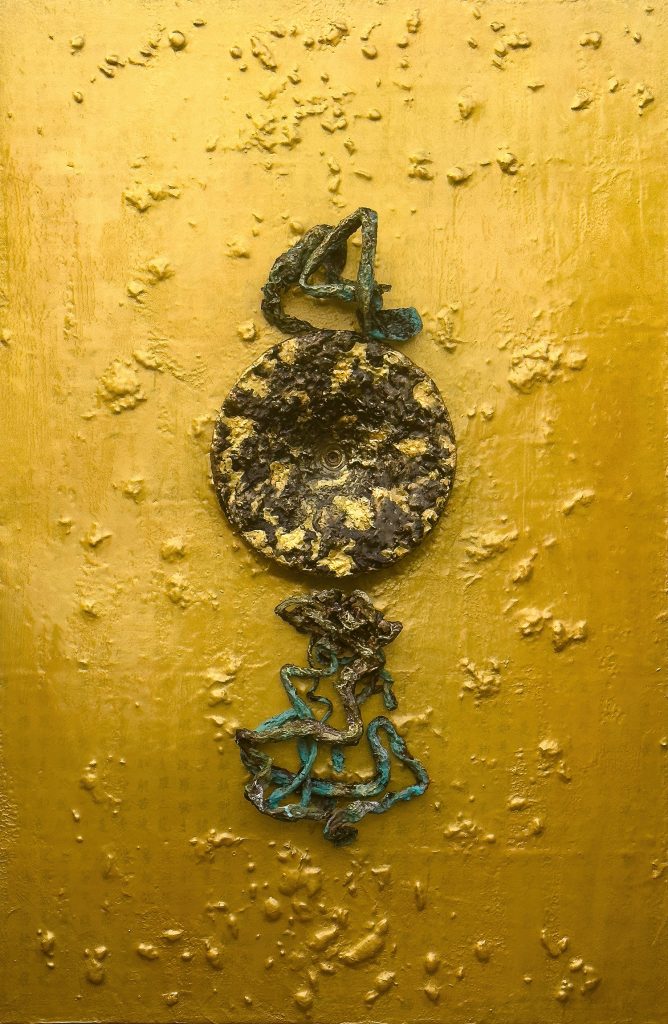
Lipont Gallery is delighted to present “CYCLES OF BEING,” a new exhibition featuring sculpture and mixed media artworks by established Vancouver-based artist, Yuri Elperin. The exhibition opens on November 15th, 2025, with a public reception from 5 PM to 9 PM.
The artistic output of Yuri Elperin is a profound and expansive inquiry into history, culture, and spiritual beliefs. Spanning several decades, his work is not merely a reflection of his personal journey but represents an artist’s continuous questioning of humanity’s collective memory and universal spiritual values.
Born in Riga, Latvia, one year after WWII, Elperin’s early years were shaped by the beautiful architecture and design of a city that had largely escaped the war’s destruction. This environment instilled in him a strong, early appreciation for art and antiquity. His true artistic awakening and stylistic conviction, however, are closely tied to a tumultuous social and political climate. While studying at the Riga Art Academy, he discovered a passion for the blend of intellectual rigor and emotional engagement found in abstract art, with a particular focus on sculpture, photography, and cinematography. However, his pursuit of Abstract Expressionism (especially the Neo-Dada movement) was deemed unacceptable at that time, leading to persecution and his forced withdrawal from the academy.
This profound desire for creative freedom ultimately led to his emigration to the West in 1977. During his time in Rome, and his subsequent travels and research across Spain, France, and Italy, he immersed himself in Western modern art, drawing significant influence from masters such as Gerhard Richter, Antoni Tapies, Pierre Soulages, and Alberto Burri. These experiences not only enriched his visual language but solidified his artistic convictions. For decades, alongside his commercial photography and film career in Vancouver, Canada, he persistently pursued his art projects, developing a unique process for photographic collages and mixed media.
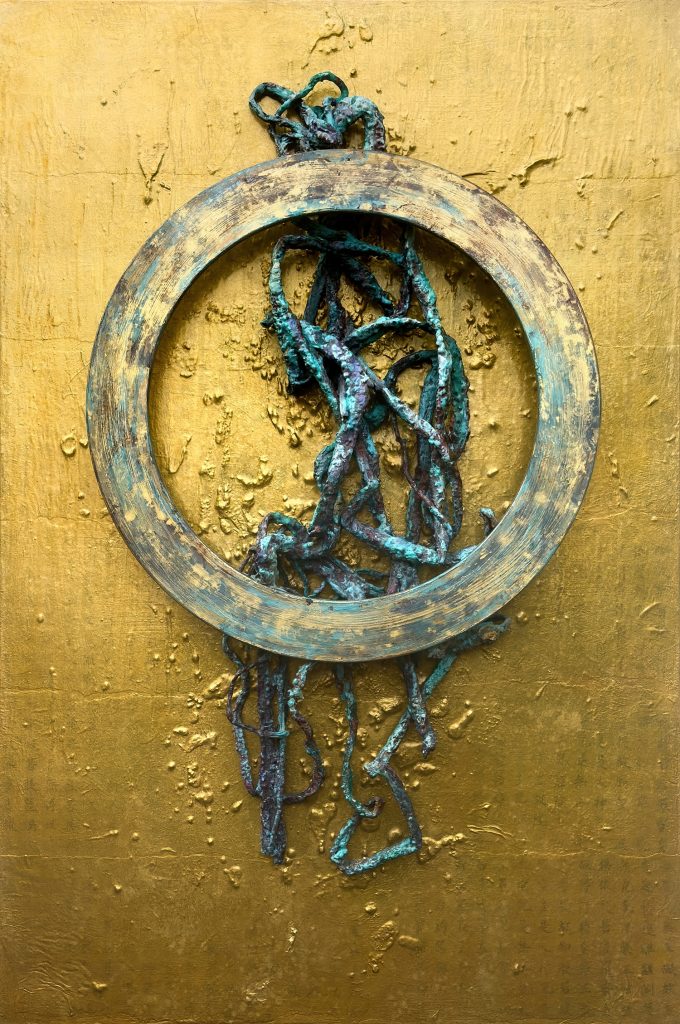
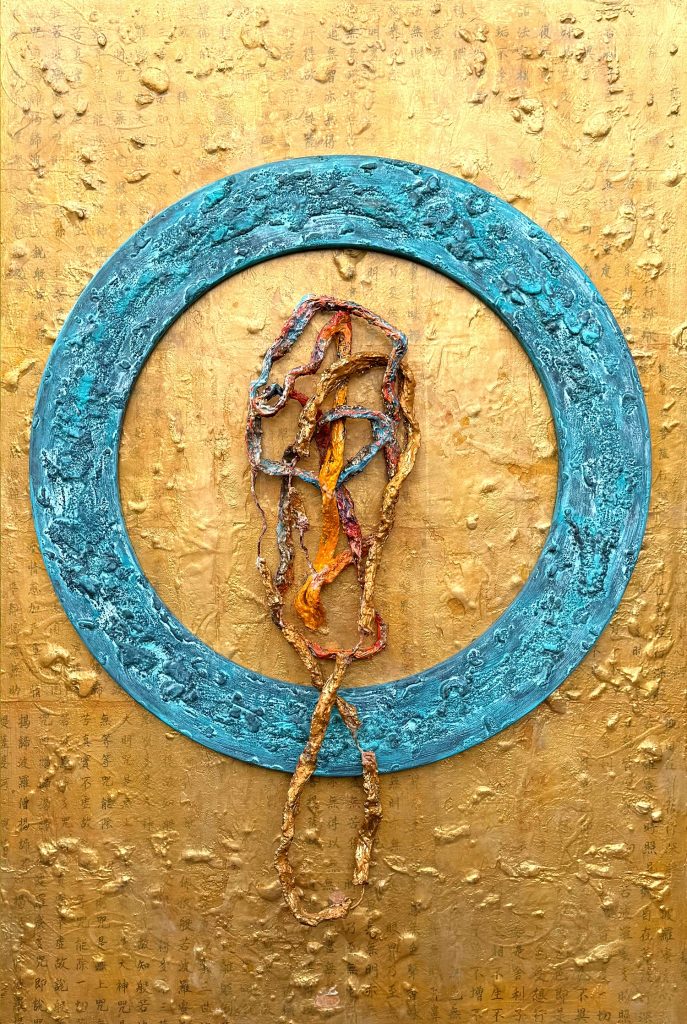
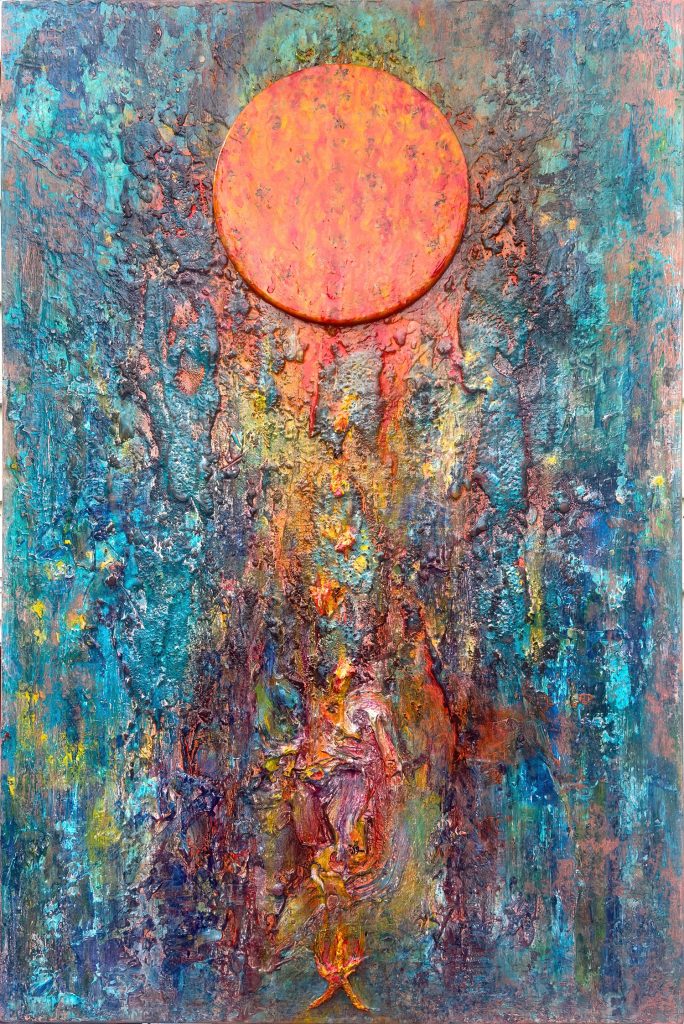
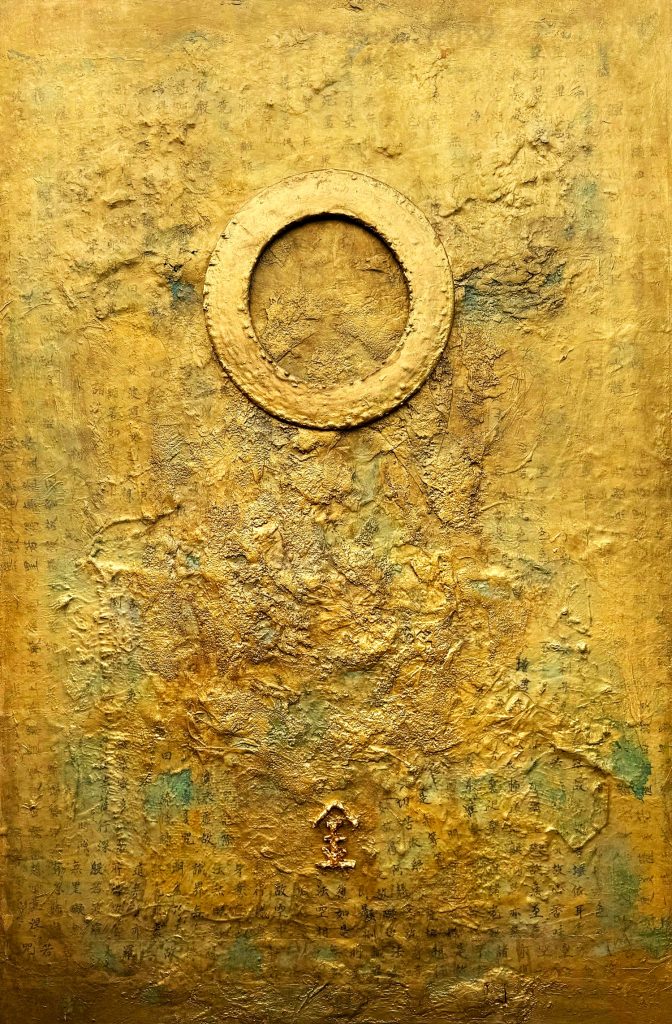
Since dedicating himself full-time to art in 1998, Elperin’s work has entered a powerful new phase—his three-dimensional Neo-Expressionism. Recent pieces, described as “sculpture/painting,” such as Phase One, Reincarnation Begins, and Metamorphosis, intentionally blur the lines between traditional media. They construct unique visual spaces through dynamic three-dimensional structures and complex material collages.
Elperin’s themes are grand and far-reaching; he commits himself to exploring the histories, mythologies, knowledge, legends, and canons of different cultures. This is clearly demonstrated in his cross-cultural narratives, from works inspired by Chinese history, such as Wu Zetian Dream and Transmigration Dragon/Emperor, to pieces delving into Eastern philosophies, like Beginning of Endless Knot, Buddha Eye, and Something is Nothing and Nothing is Something.
A significant and deeply meaningful element in this cultural exchange is the integration of traditional Chinese calligraphy. The traditional Chinese calligraphy in some of Elperin’s works are by Vancouver-based artist Ning.Li (ningli.ca). Ning, Li’s disciplined, ancient script introduces a profound sense of cultural memory, meditative practice, and classical weight directly into Elperin’s contemporary, emotionally charged surfaces.
The most crucial core theme for Elperin lies in emphasizing the vital importance of spiritual beliefs within the memory of nations, civilization, and the universe. Whether contemplating life, death, and impermanence in Memento Mori and Impermanence, or exploring cosmic origins in Elements of Infinity and Material World, Elperin’s art calls for a transcendent reflection. In recent years, his focus has extended to the philosophy of the natural world, deconstructing and reassembling the “Five Elements” (Metal, Wood, Earth, Water, Fire) into mixed media works that offer a contemplative view of the universe’s fundamental composition.
Yuri Elperin’s art is a crucible where the personal history of displacement, struggle, and cross-cultural observation is fused into a singular vision. His works are not just tributes to history; they are profound meditations on humanity’s enduring spiritual realm. Viewers standing before these powerful and complex “sculpture/paintings” are invited to participate in a timeless dialogue concerning existence, faith, and memory.
For more information on artists Yuri Elperin and Ning, Li, please visit https://eastwestartguide.com/
Exhibition Dates: November 15 – December 4, 2025
Hours: Monday – Friday, 10 AM – 5 PM, or by appointment. Visit here to book.
Address: Lipont Place, Room 218 (no elevator), 4211 No. 3 Road, Richmond, BC, V6X 2C3
Admission: Free
Parking: Free on the south side of the building only.
Transit: Aberdeen Station
Contact: www.lipontgallery.ca, 604-285-9975
【存在之循环】悠睿·埃尔佩林艺术展
开幕:2025年11月15日星期六晚 5:00 – 9:00
https://yuriopening.eventbrite.ca
艺术家见面会:2025年11月26日下午3:00 – 5:00
https://meetyuri.eventbrite.ca
展览:2025年11月15日 – 12月4日
週一至週五10am-5pm开放,或预约参观。
温哥华力邦美术馆荣幸推出全新展览【存在之循环】,展出温哥华知名艺术家悠睿·埃尔佩林 (Yuri Elperin) 的雕塑及多媒介作品。展览将于2025年11月15日星期六晚5:00 – 9:00时开幕。
悠睿·埃尔佩林的艺术创作是对历史、文化和精神信仰的深刻而广泛的探索。他的作品跨越数十年,不仅反映了他的个人旅程,更代表了艺术家对人类集体记忆和普世精神价值的持续探究。
埃尔佩林出生于二战结束后一年的拉脱维亚里加市,这座城市的优美建筑和设计深深地影响着他的童年。里加市在很大程度上躲过了战争的摧残,这样的环境在他早期培养了他对艺术和古迹的强烈欣赏。然而,他真正的艺术觉醒和风格信念与动荡的社会环境息息相关。在里加艺术学院学习期间,他发现自己对抽象艺术中融合了严谨的智识与丰富的情感投入的艺术风格充满热情,尤其专注于雕塑、摄影和电影摄影。然而,他对抽象表现主义,尤其是新达达主义的追求在当时被认为是不可接受的,这导致他被迫退学。
对创作自由的强烈渴望最终促使他于1977年移居西方。在罗马期间,以及随后在西班牙、法国和意大利的旅行和研究使他沉浸在西方现代艺术中,并深受格哈德·里希特 (Gerhard Richter)、安东尼·塔皮埃斯(Antoni Tapies)、皮埃尔·苏拉吉(Pierre Soulages)和阿尔贝托·布里(Alberto Burri)等大师的影响。这些经历不仅丰富了他的视觉语言,也坚定了他的艺术信念。埃尔佩林于1978年移居加拿大。几十年来,除了在温哥华从事商业摄影和电影事业外,他还坚持不懈地追求自己的艺术项目,并发展出独特的摄影拼贴和混合媒介创作方式。
自1998年全身心投入艺术创作以来,埃尔佩林的创作进入了一个强有力的新阶段——他的三维新表现主义。他近期创作的一系列被称为“雕塑/绘画”的作品,例如《第一阶段》、《轮回开始》和《蜕变》,有意模糊了传统媒介之间的界限。它们通过动态的三维结构和复杂的材料拼贴,构建出独特的视觉空间。
埃尔佩林的创作主题宏大而深远;他致力于探索不同文化的历史、神话、知识、传说和经典。这在他的跨文化叙事中得到了清晰的体现,从受中国历史启发的作品,例如《武则天之梦》和《龙的转生》,到深入探讨东方哲学的作品,例如《无尽结之始》、《佛之眼》和《有即无,无即有》。
在埃尔佩林的作品中,一个意义深远且影响广泛的元素是传统中国书法的融入。温哥华艺术家宁莉 ningli.ca 首先在纸上创作了传统中国书法作品。随后,埃尔佩林将这些书法原作作为拼贴元素融入到他的混合媒介作品中。宁莉严谨的古体书法为埃尔佩林充满当代气息、情感饱满的作品注入了深厚的文化记忆、冥想般的修行以及古典的厚重感。
埃尔佩林最重要的核心主题在于强调精神信仰在民族、文明和宇宙记忆中的至关重要。无论是在《死亡警示》和《无常》中对生命、死亡和无常的思考,还是在《无限元素》和《物质世界》中探索宇宙起源,埃尔佩林的艺术都呼吁一种超越性的反思。近年来,他的创作重点延伸至自然界的哲学,将“五行” (金、木、土、水、火) 解构并重组,创作出混合媒介作品,以沉思的视角审视宇宙的基本构成。
悠睿·埃尔佩林的艺术如同熔炉,将个人的奋斗历程和跨文化观察融合成一个独特的视角。他的作品不仅是对历史的致敬,更是对人类永恒精神境界的深刻思考。观众站在这些强大而复杂的“雕塑/绘画”前,被邀请参与一场关于存在、信仰和记忆的永恒对话。
请访问https://eastwestartguide.com/ 了解更多关于悠睿·埃尔佩林和宁莉的艺术。
展览日期:2025年11月15日至12月4日
时间:周一至周五,早10时至晚5时,或点此预约。
地址:Lipont Place 218室 (无电梯),4211 No. 3 Road, Richmond, BC, V6X 2C3
门票:免费
停车:仅限楼南免费停车。
交通:Aberdeen天车站
联系方式:www.lipontgallery.ca 604-285-9975
Yuri Elperin – Artist Biography
Yuri Elperin was born in Riga, Latvia, one year after WW2. During the war, Riga’s buildings and structures suffered little damage, unlike most European cities. As a young boy, Elperin was lucky to live in an area surrounded by beautiful architecture, art, and design. Affected by his environment, he went on to develop a strong taste and love for art and antiquity.
From 1961-1965, Elperin’s parents sent him to “Pioneer Palace”, an academy in Riga for young artists. His full-time studies were interrupted upon conscription into the Russian army (1965-1968).
After completing his mandatory military service, he continued his education in design, architecture, and industrial technology at Kaliningrad College. In 1974, Elperin enrolled at the Riga Art Academy. There, he discovered his passion for combining intellectualist methodology and emotional and physical engagement in abstract art. Sculpture, photography, and cinematography were of particular interest.
However, the prevailing communist culture did not recognize abstract expressionism (especially the Neo-Dada movement) as art. During this period, artists in Soviet Latvia did not have true freedom and were often persecuted. Following a miscommunication with the administration, Elperin was asked to withdraw from the Riga Art Academy.
Elperin’s many attempts to leave the Iron Curtain for the West were met with success. In 1977, he left Latvia. While awaiting Canadian immigrant status, he lived in Rome. He continued developing his acumen through researching galleries and museums in Spain, France, and Italy. There, Elperin was introduced to artists such as Gerhard Richter, Antoni Tapies, Pierre Soulages, and Alberto Burri, who have been significant influences on his work.
Elperin moved to Canada in 1978. He set up a commercial photography and film studio, working full-time with advertising agencies, in Vancouver, B.C. At the same time, he continued working on his art projects. In the 1980’s, he developed a very unique process for photo collages. His rich-in-colour abstract mixed media art is well known, especially his “Jazz Project”.
Elperin left his business in 1998 in order to fully dedicate himself to art. Now, he resides in Vancouver, where his main studio is located, while sharing a part-time studio in Brooklyn, New York.
Over the past two decades, Yuri Elperin has concentrated on developing his three-dimensional Neo Expressionism projects. His art explores the histories, mythologies, knowledge, legends, and canons of different cultures. Through his work, Elperin brings up the importance of spiritual beliefs in the memory of nations, civilization, and universe.
悠睿·埃尔佩林 – 艺术家简介
悠睿·埃尔佩林(Yuri Elperin)在二战结束一年后出生于拉脱维亚里加。与大多数欧洲城市不同,里加的建筑物在战争期间几乎没有遭到破坏。埃尔佩林童年时很幸运地生活在一个被美丽的建筑、艺术和设计所包围的地区。受环境的影响,他逐渐培养了对艺术和古董的浓厚兴趣和热爱。
1961年至1965年,埃尔佩林的父母将他送往里加一所面向年轻艺术家的学院“先锋宫”(Pioneer Palace)。1965年至1968年,他因应征入伍俄罗斯军队而中断了全日制学业。
服完兵役后,他继续在加里宁格勒学院学习设计、建筑和工业技术。1974年,埃尔佩林进入里加艺术学院学习。在那里,他发现了自己对将理性主义方法论与情感和身体投入相结合的抽象艺术的热情。他对雕塑、摄影和电影摄影尤为感兴趣。
然而,当时盛行的共产主义文化并不承认抽象表现主义(尤其是新达达主义运动)是艺术。在此期间,苏联时期的拉脱维亚艺术家没有真正的自由,经常遭受迫害。由于沟通不畅,埃尔佩林被勒令退出里加艺术学院。
埃尔佩林多次尝试离开铁幕,前往西方,并最终取得成功。1977年,他离开了拉脱维亚。在等待加拿大移民身份期间,他居住在罗马。他通过研究西班牙、法国和意大利的画廊和博物馆,继续提升自己的艺术造诣。在那里,埃尔佩林结识了格哈德·里希特、安东尼·塔皮埃斯、皮埃尔·苏拉热和阿尔贝托·布里等艺术家,他们对他的作品产生了重大影响。
埃尔佩林于1978年移居加拿大。他在卑诗省温哥华市开设了一家商业摄影和电影工作室,全职与广告公司合作。与此同时,他继续从事自己的艺术项目。 20世纪80年代,他发展出一种非常独特的照片拼贴技法。他色彩丰富的抽象混合媒介艺术广为人知,尤其是他的“爵士乐系列”。
埃尔佩林于1998年辞去工作,全身心投入艺术创作。如今,他居住在温哥华,主要工作室也设在温哥华,同时在纽约布鲁克林有一间共享工作室。
在过去的二十年里,尤里·埃尔佩林专注于发展他的三维新表现主义作品。他的艺术探索了不同文化的历史、神话、知识、传说和经典。埃尔佩林通过他的作品,提出了精神信仰在民族、文明和宇宙记忆中的重要性。
Forms of Memory: Yuri Elperin’s Art and the Wirkungsgeschichte of the Human Spirit
Tiehan Wu
Standing before the works of Yuri Elperin, one feels as though standing amid a relic constructed jointly by history and time, culture and spirit. The layers of paper, wood, metal, fabric, and pigment are not merely a convergence of materials, but a condensation of memory and history. His art releases form from the constraints of the material world, transforming it into a manifestation of spiritual resonance. As the philosopher Hans-Georg Gadamer observed, human understanding itself is a historical mode of existence. Therefore, an artwork does not passively present the past; it continually generates new meaning within the process of Wirkungsgeschichte—the “effective history” through which understanding unfolds. Elperin’s creative practice embodies this very process: an existential experience articulated through matter as language and time as medium.
The Historicity of Artistic Formation
Understanding is historical; every interpretation of art is rooted in preconceptions and tradition. Elperin’s artistic trajectory concretizes this insight. Born in postwar Latvia, he grew up in a world torn apart by war and ideology. The artistic languages he absorbed combined the rigorous structure of the Soviet academic school with the spiritual rebellion of the underground abstract movement. When he left his homeland in pursuit of creative freedom—first to Europe and later to Canada—his horizon was continually reshaped; each migration became a new pre-understanding of the world.
This fluid experience lends his works a tactile sense of history: the oxidation of metal, the cracks in wood, the burn marks on paper—all serve as the grammar of time. In works such as Metamorphosis and Phase One, what we encounter is not mere formal experimentation but the sedimentation of time. They resemble geological strata compressed by the weight of centuries, revealing the artist’s meditation on existence and renewal. Here, the historicity of understanding becomes a historicity of form: form is no longer an external ornament but the visible manifestation of lived history. The artist’s understanding is never detached from history; it is shaped by it. Thus, Elperin’s art becomes a visual consciousness of history—an ontological poetics materialized through matter.
From Personal Memory to the Spirit of Humanity
Understanding always unfolds within the chain of historical effects; our perspectives are already shaped by history. Elperin’s art continues this dynamic of historical influence. In his work, art is not merely an expression of personal emotion but a vessel for the spiritual memory of humanity. Many of his pieces draw upon religious and mythological imagery—The Eye of Buddha, Wu Zetian’s Dream, The Transmigration of the Dragon, and The Beginning of the Endless Knot. These works do not simply retell tradition; they allow tradition to speak anew within contemporary cultural contexts.
This process of “speaking anew” is the concrete manifestation of effective history within art. The meaning of a work is never fixed; it is continuously rewritten through the viewer’s perception and the transformation of cultural context. When facing The Eye of Buddha with its silent gaze, or Something Is Nothing and Nothing Is Something with its paradoxical structure, the understanding that occurs is not a restoration of the artist’s intention but a new historical encounter. Both artist and viewer exist within the continuum of history, together forming the work’s living history. Elperin’s art, therefore, is not a nostalgic return to history but a way of letting history remain effective—a spiritual manifestation propelled by time itself.
Fusion of Horizons and Cross-Cultural Imagery
Elperin combines Eastern spirituality with Western modernist experimentation, allowing different civilizational symbols to meet and generate new meanings. The Eastern notion of cyclical existence—birth and extinction, emptiness and form, the visible and the invisible—intertwines with the Western pursuit of formal freedom and material deconstruction, fusing ultimately into a single vision.
In his Five Elements series, metal, wood, water, fire, and earth cease to be mere natural symbols; they become artistic metaphors of cosmic order. The hardness and luster of metal suggest the endurance of form; the texture and vitality of wood express growth; the interplay of water and fire evokes tension and regeneration; and the heaviness of earth anchors the composition with ontological gravity. This reconfiguration of the Five Elements is a fusion of horizons between cultural perspectives. In viewing these works, one perceives not only the meeting of cultures but also the emergence of meaning itself—a visual enactment of hermeneutic fusion.
In Elperin’s art, this fusion operates not only at the thematic level but also through material processes. Metal welding, wooden collage, photographic fragments, and layered pigments are woven together so that the medium itself becomes a metaphor for cultural dialogue. Understanding, therefore, is not the restoration of the past but the creation of new meaning through the encounter of horizons. Elperin’s art comes alive precisely in this act of generation.
Understanding as Existence: Metaphysical Transcendence
Elperin’s works never remain at the level of representation or symbol; rather, they reveal the ontology of understanding through the existence of art itself. In his recent series—Cycle of Existence, Elements of Infinity, and Impermanence—form’s emergence and dissolution, light and darkness, matter and void interweave to create a metaphysical experience. Viewing becomes not a passive cognition but an act of participation in being.
The viewer, facing the work, is drawn into a silent dialogue—not with the artist, but with existence itself. Each act of seeing becomes an event of understanding, and this understanding is not external to us but constitutive of our being. Through this, Elperin completes a passage from the material world to the spiritual: art ceases to be an image about the world and becomes the world’s own manifestation.
Conclusion
Yuri Elperin’s art is a form of effective history shaped by time, culture, and spirit. Interweaving Eastern systems of belief with Western formal languages, he creates a new visual order in which the work itself becomes an event of self-understanding. Within these sculptural/painting hybrids filled with material tension, existence, memory, and transcendence are not separate themes but parts of a continuous cycle—a process through which the human spirit reveals itself in history. In Elperin’s artistic world, form is memory, form is history, and in the luminous moment of art, one perceives the resonance of eternal transcendence and the human spirit.
记忆的形体:悠睿·埃尔佩林的艺术与人类精神的效果历史
文/吴铁汉
在悠睿·埃尔佩林(Yuri Elperin)的作品前,我们仿佛站在一座由历史与时间、文化与精神共同构筑的遗迹之中。纸张、木材、金属、布料与颜料的层叠,不仅仅是质料的汇合,更是历史与记忆的凝结。他的艺术将“形”从物质世界中解放出来,使其成为精神回响的显现。正如哲学家伽达默尔所指出的:人类的理解本身就是一种历史性的存在方式。因此,艺术作品并非被动地呈现过去,而是在“效果历史”(Wirkungsgeschichte)之中不断生成新的意义。埃尔佩林的创作正是这种理解的形体化——一个以物质为语言、以时间为媒介的存在经验。
历史性的艺术生成
理解具有历史性,任何艺术诠释都根植于“前见”与“传统”的作用之中。埃尔佩林的创作轨迹正是这一思想的具象化:他出生于战后拉脱维亚,在战争与意识形态撕裂的世界中成长,所吸收的艺术语言既有苏联学院派的严谨结构,也有地下抽象艺术的精神叛逆。当他因追求创作自由而离开故乡,迁居欧洲再到加拿大,他的“视域”被不断重塑——每一次迁移都成为理解世界的新前见。
这种流动的经验,使他的作品带有一种被历史触摸的质感:金属的氧化、木头的裂纹、纸面的燃痕,皆是时间留下的语法。在《蜕变》《第一阶段》等作品中,我们看到的并非单纯的形式实验,而是时间的沉积。它们如同被岁月压层的地质结构,揭示了艺术家对存在与再生的思索。此处,“理解的历史性”转化为“形的历史性”:形式不再是外在装饰,而成为历史经验的显形。艺术家的理解并非脱离历史,而是被历史塑造的存在方式;埃尔佩林的艺术因此成为一种视觉化的历史意识——一种在物质中显现的存在论诗学。
从个人记忆到人类精神
理解总在历史的作用链中展开,我们的视角已被历史塑造。埃尔佩林的艺术作品正是这种历史作用的延续。在他的作品中,艺术不只是表达个人的情感,而是承载人类精神记忆的容器。他的作品多以宗教与神话意象为引线,例如《佛之眼》《武则天之梦》《龙的转生》《无尽结的开始》——这些作品并非重述传统,而是让传统在新的文化语境中继续发声。
这种“继续发声”的过程,正是作用的历史在艺术中的具体体现。作品的意义并非固定,而是在观者的观看与文化语境的变化中被不断重写。当观众面对《佛之眼》的沉默凝视,或《有即无,无即有》的悖论结构时,所发生的理解并非对艺术家意图的还原,而是一场新的历史交互。艺术家与观众都处于历史的延续中,他们共同构成了作品的“活着的历史”。埃尔佩林的艺术因此不是对历史的回望,而是一种使历史继续起作用的方式——一种“被时间推动的精神显现”。
视域融合与跨文化的形象生成
艺术家将东方信仰与西方现代主义的形式实验结合,使不同文明的象征体系在作品中相遇并生成新的意义。东方文化中的“循环”观念——生与灭、虚与实、形与无形——与西方现代艺术的形式自由、材料解构在他的作品中互相吸收,最终融为一体。
在《五行》系列中,金、木、水、火、土不再只是自然元素的象征,而成为宇宙秩序的艺术隐喻。金属的坚硬与光泽象征形式的持久性,木的纹理与流动体现生命的生长,水与火的交错暗示冲突与再生,而土的厚重则为整个构图提供存在的根基。这种五行的重组,正是不同文化视域之间的融合。观众在观看时,不仅看到文化的交汇,更体验到意义的生成:一个被形象化的“视域融合”过程。
在埃尔佩林的作品中,这种融合不仅是主题层面的,也是材料层面的——他将金属焊接、木质拼贴、摄影碎片与绘画色层叠合,使媒介本身成为文化交流的隐喻。理解并非对过去的复原,而是“通过视域的相遇生成新的意义关系”。埃尔佩林的艺术就在这种生成中获得生命。
理解即存在:形而上的超越
埃尔佩林的作品从未停留在再现或象征的层面,而是以艺术自身的存在来显现“理解的本体论”。在他最新的系列《存在的循环》《无限元素》《无常》中,形式的生成与消解、光与暗、物质与虚空彼此交替,构成了一种形而上的体验:观看不再是被动的认知,而是一种参与存在的行为。
观者面对作品时,仿佛被卷入一场沉默的对话——不是与艺术家,而是与存在本身。每一次观看都是一次“理解的事件”,而这种理解并非外在于我们,而是构成我们生命经验的方式。埃尔佩林以此完成了从物质世界向精神世界的过渡:艺术不再是关于世界的图像,而成为世界自身的显现。
小结
悠睿·埃尔佩林的艺术是一种被历史、文化与精神共同塑造的“效果历史”。他以东方的信仰体系与西方的形式语言交织出一个新的视觉秩序,使作品成为理解自身的存在事件。在这些充满物质张力的雕塑/绘画之中,存在、记忆与超越并非彼此分离的主题,而是一个持续展开的循环——一个人类精神在历史之中自我显现的过程。在埃尔佩林的艺术世界里,形体即记忆,形式即历史,而艺术的闪光处,正是那永恒的超越性与人类精神的共鸣。